By George Saoulidis (@georgecursor)
June 2026 | Marousi, Athens
“If you’ve adopted AI at your company but haven’t seen any tangible results, read this 1990 article: “The Dynamo and the Computer” by Paul David. When electricity first arrived, factories that “adopted” it barely got faster. They just swapped the steam engine for an electric one and ran everything else exactly as before: same machine layout, same workflow, same management.
Electricity in, no real gains out. The most common mistake with any new technology is to drop it into the old organization and then declare the transformation done. The real leap came decades later, when each machine got its own small motor.
Suddenly machines no longer had to be lined up around one central drive shaft. They could be rearranged around the actual flow of work. The productivity gains didn’t come from electricity. They came from REDESIGNING THE ENTIRE FACTORY around it.
AI is the same. Bolting it onto your existing process gets you a faster steam engine. The payoff comes when you redesign the work itself.”
https://x.com/zarazhangrui/status/2064088872494194753?s=20
Click to access 1990-david.pdf
A post on X recently shared this 1990 insight from economist Paul David, comparing the slow productivity gains from early electricity adoption in factories to today’s AI rollout. Factories initially just swapped steam engines for electric motors but kept the same central drive shaft layout, workflows, and management. Real gains only arrived decades later when they redesigned everything around individual electric motors on each machine.
The analogy landed hard for me. I’m living it right now in my own businesses.
The Old Way: Bolting AI Onto Legacy Processes
For years as an indie author, content creator, and entrepreneur, I did what most people do: I adopted AI without redesigning the work.
I used ChatGPT or similar for brainstorming book ideas or ad copy.
Generated some covers with early image tools.
Outsourced editing, formatting, marketing tasks to freelancers or small teams.
Ran my Forever Living affiliate shop with mostly manual processes and occasional AI assistance.
Created X threads, YouTube shorts, and TikTok content in fits and starts.
The result? Higher output than pure manual work, sure. But still bottlenecks everywhere. High costs from team overhead. Inconsistent quality because context got lost between handoffs. Creative compromises because I couldn’t afford to iterate endlessly. And honestly, the promised exponential productivity never fully materialized. It felt like strapping a faster engine onto the same old factory floor.
Sound familiar?
The Pivot: “I Fired My Whole Team. Now It’s Just Me, My Hermes Agent, and Profits.”
A few weeks ago, I made a clean break. I let the team go. No more dependency on external writers, designers, or marketers for core work.
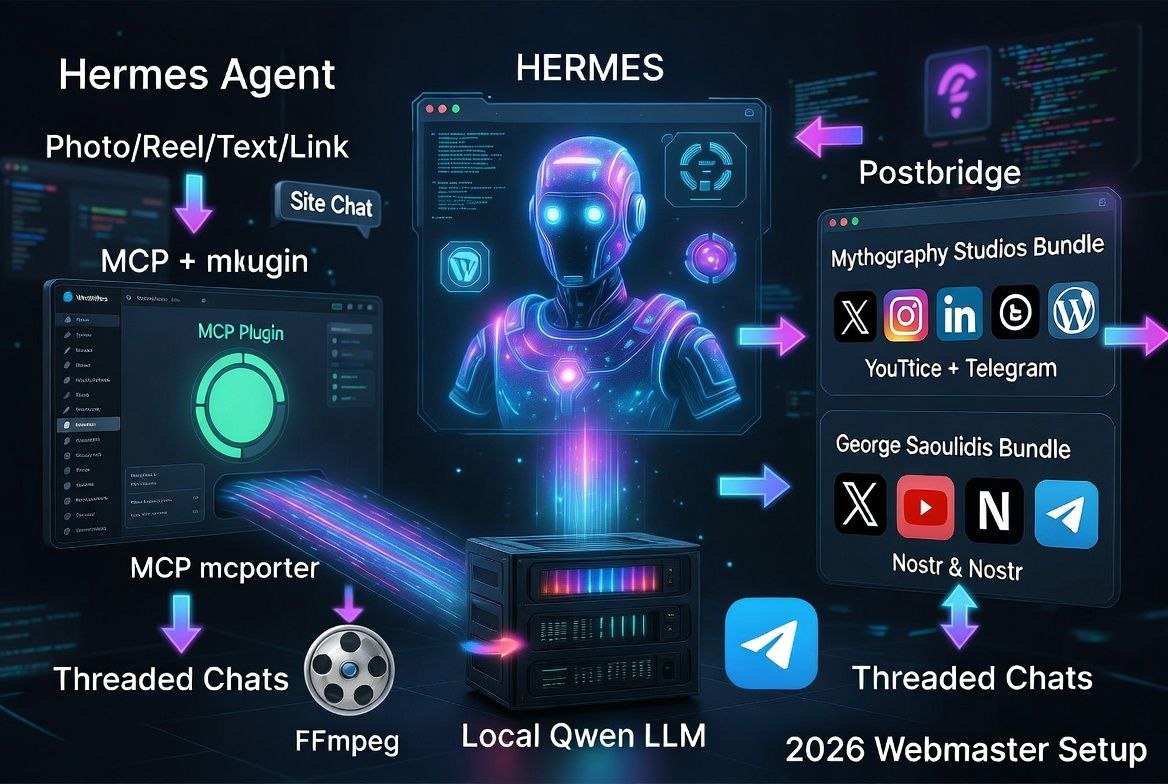
Now it’s just me and Hermes — my persistent, multi-instance AI agent ecosystem — and we’re seeing real profits.
This wasn’t about replacing humans with AI in the old structure. It was about redesigning the entire operation around what AI agents can actually do when given proper memory, tools, context, and integration.
Hermes isn’t a simple chatbot or one-off prompt system. It’s built for depth:
Persistent memory and project context across sessions, books, and campaigns (no more re-explaining everything every time).
Deep tool integration: Local LLMs via Ollama (Qwen for vision and cron jobs, DeepSeek and others), ComfyUI for high-quality image generation, API hooks, Telegram for always-on control from my phone, and custom automation.
Runs on sovereign local hardware: My heavily modded NVIDIA DGX Spark setup in Marousi — with Noctua cooling, thermal paste experiments from ASIC miners, oil immersion tests for silence, UPS protection, fiber networking, and balcony solar/wind experiments to offset power costs (tying nicely into my Bitcoin self-custody and mining interests on @loveisbitcoin21).
Specialized instances for different workflows, all orchestrated under one “agent OS” mindset.
This is the equivalent of giving every “machine” in my business its own electric motor and rearranging the floor around the actual flow of value.
AI-Native Workflows in Practice
Book Creation & Publishing Pipeline
As an indie author focused on LitRPG, speculative fiction, and niche adult genres, consistency across series is everything. Hermes maintains long-term context files for characters, world-building, and my personal style. It handles research, outlining, iterative drafting, and refinement. When it’s time for visuals, it generates precise, detailed prompts for ComfyUI to create custom covers and assets. Translations prep for platforms like Babelcube flows naturally. What used to require multiple freelancers and weeks now happens faster with higher fidelity to my vision.
I even experiment with Twine for interactive versions when it fits a story.
Forever Living Marketing Engine
For my Forever Living Products affiliate business in Greece (Clean 9 programs, Vitolize, Freedom supplements, aloe-based wellness), traditional advertising is expensive and hard to scale.
I redesigned it around AI influencers — generated personas like Daphne, and Haze (edgy villain vibe). Hermes powers the end-to-end pipeline: concept development, script writing tailored to geo-targeted Greek audiences, visual generation, and campaign orchestration across TikTok and Instagram multi-account setups. This avoids blocks while delivering authentic-feeling, high-converting content. “Beat the fridge” messaging and supplement education now runs with minimal manual intervention.
Content, Bitcoin Education & Community
On X (@georgecursor for AI/entrepreneurship, YouTube (@glowleaf3 for fantasy visuals and mythology-inspired shorts), and elsewhere, Hermes helps maintain thread series, meme creation, script outlining, and visual production. For Bitcoin topics — self-custody starter kits, mining profitability analysis, Lightning limitations, and HODL philosophy — the agent keeps technical accuracy and my voice consistent without constant context reloading.
Operations & Infrastructure
Hermes even helps with the meta-work: Linux server management (“I love Linux now that Hermes handles it”), cron jobs, vision-based tasks, debugging my homelab setups, and monitoring. The occasional hilarious glitch (like defaulting to Greek responses despite English input) reminds me we’re still early, but the overall leverage is massive.
I cancelled pricey subs like MailerLite and ChatGPT because the agent-native approach handles automation and distribution more effectively at lower cost.
The Glimpses of Real Productivity (and Profits)
I’m not claiming perfection or overnight millions. But the shift is tangible:
Speed and iteration: From idea to published book asset or live ad campaign in days instead of weeks or months.
Cost collapse: No team salaries or bloated tool stacks. Local inference on my own hardware keeps recurring costs near zero.
Creative control: I can explore deeper into my preferred genres and aesthetics without budget or coordination friction.
Consistency and memory: Projects don’t lose context. The “team” (agent instances) remembers my goals, past decisions, and brand voice.
Bottom line: Profits are emerging because overhead dropped while output quality and volume rose. This is the part most “AI adoption” stories miss — the redesign has to reach the P&L.
Just like those early 20th-century factories, the gains aren’t from the technology alone. They’re from the organizational and process redesign.
What This Means for Other Builders and Solopreneurs
If you’re bolting AI tools onto your existing company org chart, hiring processes, or creative workflow and wondering why the magic isn’t happening at scale, this is why.
The lesson from electricity (and now AI) is clear:
Map your end-to-end value flows — every step from idea to customer or reader.
Reimagine each step with persistent agents in mind — give them memory, tools, and clear interfaces.
Build (or adopt) infrastructure that supports 24/7 agent operation — local hardware where sovereignty, cost, and privacy matter (Bitcoin taught me this too).
Treat prompting, context engineering, and agent orchestration as core business skills, not side tasks.
Start with one high-leverage workflow and fully redesign it before expanding. Don’t try to electrify the whole factory at once.
Large corporations with legacy structures will struggle here. The real opportunity is for agile solopreneurs and small teams who can move fast and redesign from first principles.
I’m still early in this journey. There are rough edges — model limitations, platform shadowbans requiring creative workarounds, hardware tinkering for silent reliable operation, and the constant evolution of the agent stack (Hermes is my dogfooded solution, evolving alongside WriterOS experiments for writing-specific flows).
But the direction is unmistakable. The winners won’t be those with the most AI subscriptions. They’ll be those who rebuilt their “factory” around the new power source.
“The productivity gains didn’t come from electricity. They came from REDESIGNING THE ENTIRE FACTORY around it.”
— Paul A. David, “The Dynamo and the Computer” (1990)
The Road Ahead
I’m documenting more of these experiments openly on X. You’ll see Hermes in action (sometimes arguing with me in Greek), local AI homelab builds, Forever Living campaign results, new book drops, Bitcoin self-custody tools, and whatever else we’re redesigning next.
Related experiments include @GreekAigr for localized Greek AI creative tools and image work, and @mythographys for mythology-infused projects.
If this resonates — if you’re tired of AI feeling like an expensive add-on instead of a transformative force — start redesigning one process today. Build or connect a persistent agent with real memory and tools. Run it locally if you value control.
The central drive shaft era is ending. The age of distributed, agent-native operations is just beginning.
And for those of us willing to do the redesign work, the productivity (and profits) are finally arriving.
Follow the journey:
@georgecursor
Inspired by the conversation around this post and Paul David’s timeless insight.
This article was written with the assistance of my own agent systems as part of the redesigned workflow.



0 Comments